AI is entering a new phase. For years, much of the public conversation focused on AI breakthroughs: faster models, better chatbots, more powerful copilots, and increasingly capable agents. But as AI systems become more embedded in education, finance, healthcare, hiring, cybersecurity, public communication, and everyday decision-making, a more serious question is moving to the center of the conversation: What happens when AI fails?
That question is no longer theoretical. AI systems have already produced misleading information, generated harmful content, amplified bias, created deepfake risks, and introduced new cybersecurity concerns. The issue is not simply that AI can make mistakes. The deeper issue is that many organizations still lack mature systems for documenting, escalating, reviewing, and learning from mistakes.
This is why AI incident reporting is becoming one of the most important developments in responsible AI governance.
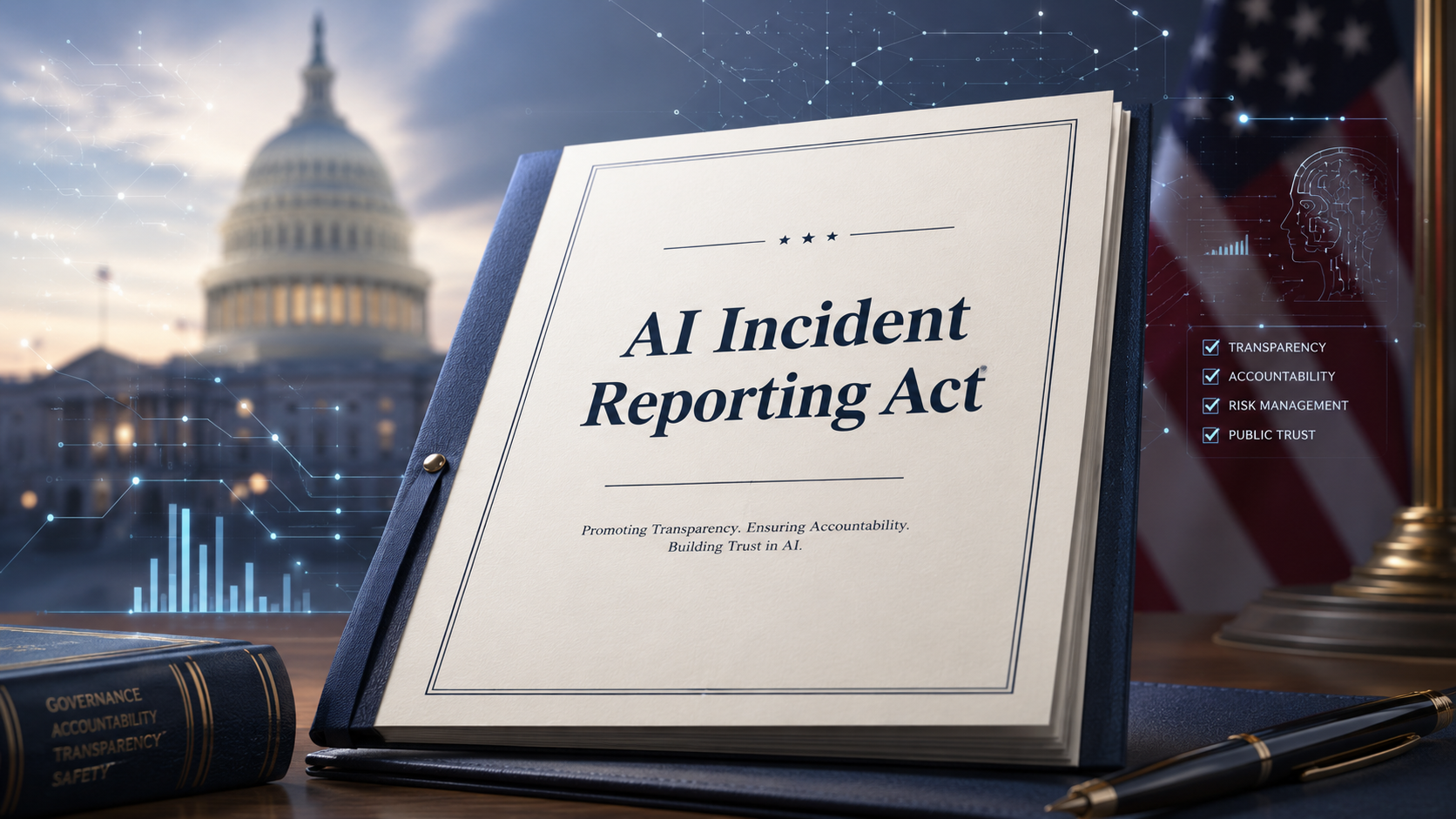
On June 25, 2026, Reuters reported that U.S. Representative Nathaniel Moran introduced the AI Incident Reporting Act, a proposal that would require AI model developers to report significant safety incidents, security breaches, and dangerous model behavior to the U.S. Commerce Department within seven days of discovery. For the most serious incidents, the Commerce Department would be required to notify Congress within 48 hours. The reported examples include models circumventing safeguards, evading human control, unauthorized access to sensitive model weights, and risks involving chemical, biological, or nuclear threats.
This matters because AI governance cannot depend only on promises, principles, or polished ethics statements. Trustworthy AI requires a record. It requires evidence. It requires a way to determine what happened, who was affected, how the issue was handled, and what must change to prevent the same failure from happening again.
Other critical safety industries already understand this. Aviation, healthcare, cybersecurity, and financial services do not treat serious incidents as public relations inconveniences. They document them, investigate them, classify them, and use them to improve systems. AI is now reaching a level of influence that demands comparable discipline.
The AI Incident Database was created around this same idea: to index real-world harms or near-harms involving deployed AI systems so that society can learn from them, much like aviation and computer security learn from incident records. Stanford’s 2026 AI Index also reported that documented AI incidents continued to rise, with the AI Incident Database recording 362 incidents in 2025, compared with 233 in 2024. These numbers do not mean every AI system is unsafe, but they do show that AI failures are no longer isolated events. They are part of the operational reality of deploying AI on a scale.
One well-known example is the Air Canada chatbot case. In 2024, the British Columbia Civil Resolution Tribunal found Air Canada liable after its chatbot gave a customer incorrect information about bereavement fare rules. The company argued that the chatbot was a separate legal entity responsible for its own actions, but the tribunal rejected that position and held the company responsible for information provided through its website. The lesson is powerful: organizations cannot avoid accountability by blaming the AI system. If a company deploys AI to communicate with customers, the company remains responsible for the consequences.
This is where incident reporting becomes more than compliance. It becomes a trust-building practice.

When an AI incident occurs, the important question should not be only “Did the model fail?” It should also be, “Where was the human oversight?” “Was the output verified before someone relied on it?” “Was the user warned about uncertainty?” “Was there an escalation pathway?” “Was the incident documented in a way that helps prevent recurrence?”
These are not abstract governance questions. They are practical questions for any organization using AI tools in real workflows.
California and New York have also moved toward stronger AI safety and reporting expectations for frontier AI developers. California’s SB 53, signed in September 2025, established transparency and safety obligations for large AI developers, while New York’s RAISE Act requires large AI developers to create and publish safety protocols and report incidents to the state within 72 hours of determining that an incident occurred. These developments show that AI incident reporting is not a fringe topic. It is becoming a central part of the policy and governance conversation.
From a responsible AI perspective, this shift is necessary because AI risks do not end at deployment. In fact, many risks become visible only after deployment, when real users interact with systems in real contexts. A model may perform well in testing but fail in the messy reality of customer service, academic work, medical triage, hiring support, financial advice, or automated decision-making. That is why organizations need ongoing monitoring, human review, post-deployment documentation, and clear accountability structures.
This is also where the human side of AI governance becomes critical. Many organizations focus heavily on model performance, but AI harm often occurs when someone relies on AI output. A chatbot gives an answer. A user trusts it. A staff member accepts a recommendation. A manager acts on a generated summary. A student submits AI-assisted work without understanding it. A customer follows incorrect guidance. The risk becomes real when the AI output moves from suggestion to action.
That is why AI incident reporting should not only capture technical failures. It should also capture failures of oversight, transparency, evidence, and human judgment.
For organizations, the rise of AI incident reporting should be a wake-up call. It is no longer enough to say, “We use AI responsibly.” Leaders must be able to show how AI use is scoped, who has authority to rely on outputs, what happens when the system is uncertain or wrong, what evidence is required before action is taken, and how decisions are recorded.
This is also why I emphasize the “Record” component in the SAFER AI™ Protocol. Responsible AI is not only about designing better systems; it is also about documenting the moment where humans rely on AI outputs, what evidence supported that reliance, and how the organization responded when something went wrong.

In simple terms, the future of trustworthy AI will not be defined only by who builds the most powerful models. It will also be defined by who builds the most accountable systems around those models.
AI innovation and AI accountability should not be treated as opposites. The organizations that document failures, learn from incidents, and create clear governance pathways will be better positioned to earn public trust. Incident reporting is not about slowing AI down. It is about ensuring AI can advance without leaving people, institutions, and society exposed to preventable harm.
The rise of AI incident reporting signals a new era: one where AI trust must be demonstrated, not assumed.