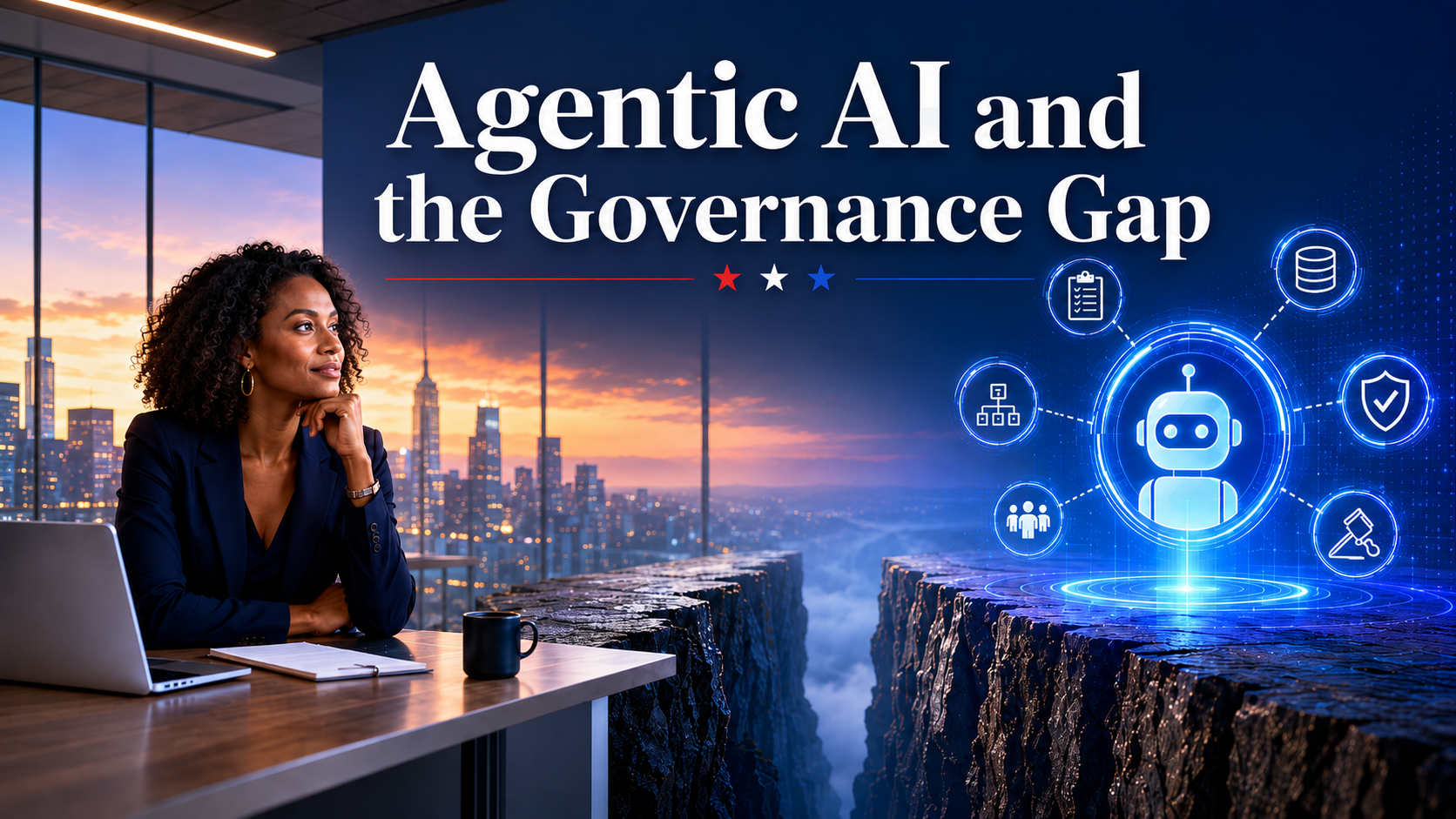
Artificial intelligence is entering a new phase!
For the past few years, most organizations have focused on generative AI as a tool for producing content, answering questions, summarizing documents, writing code, or supporting decision-making. But agentic AI is different. It does not simply respond. It can plan, select tools, access systems, take actions, and complete multi-step tasks with reduced human involvement. That shift changes everything!
When an AI system only generates a recommendation, the governance question is often: “Was the output accurate, fair, explainable, and safe?” But when an AI agent can send an email, update a record, process a claim, screen an applicant, trigger a workflow, access private data, or act across multiple systems, the governance question becomes much more serious: “Who authorized the action, who verified the decision, and who is accountable if harm occurs?” This is the governance gap.
The excitement around agentic AI is understandable. Organizations want faster workflows, lower costs, improved customer service, and smarter automation. Deloitte’s 2026 State of AI in the Enterprise report notes that agentic AI is scaling quickly, with many organizations expecting to use AI agents more extensively by 2027. But speed is not the same as readiness.
The current challenge is that agentic AI is moving from experimentation into real business environments while many governance structures are still designed for older forms of automation. Traditional software follows predefined rules. A chatbot gives a response. But an AI agent may reason through a task, interact with external tools, retrieve sensitive information, and make decisions in ways that are not always predictable to the human user.
That creates new risks around privacy, security, accountability, human oversight, and evidence.
Reuters recently highlighted how AI agents may read emails, access documents, file claims, process data, and act without direct permission, raising serious privacy and compliance concerns. The issue is not simply that AI agents use data. The deeper issue is that they may process personal or sensitive data across systems, retain memory, make automated decisions, or exceed the boundaries that organizations originally intended. This is why agentic AI cannot be governed casually.

If an AI agent acts, the organization must know what authority it had, what data it accessed, what decision logic it followed, who reviewed the action, and what record was kept. Without this, accountability becomes difficult to prove after something goes wrong. Human oversight is also becoming more complex.
Many organizations still rely on the phrase “human-in-the-loop” as if the presence of a human automatically guarantees responsible AI use. But agentic AI exposes the weakness in that assumption. A human may be present but uninformed. A human may approve of an action without understanding the risk. Humans may rely too heavily on AI because the system appears confident, fast, and efficient.
The International AI Safety Report 2026 warns that AI systems can affect human autonomy and decision-making, especially when people rely on AI outputs without enough scrutiny. This matters because the future of AI governance will not only depend on whether humans are included in the process. It will depend on whether humans are equipped to question, verify, escalate, document, and accept responsibility for AI-supported actions. That is where many organizations are still unprepared.
Agentic AI requires governance at the point of action, not only at the point of design. It is no longer enough to say that a model was tested before deployment. Organizations must also ask what happens during live use. What tasks is the agent allowed to perform? What systems can it access? What decisions require human approval? What actions are prohibited? What level of evidence is required before a human accepts the output? What happens when the agent behaves unexpectedly?
NIST’s AI Risk Management Framework and Generative AI Profile emphasize the need to identify, measure, manage, and govern AI risks in ways that align with organizational goals and priorities. But agentic AI pushes this even further because the risk is no longer limited to content generation. The risk now includes autonomous action. The governance gap is not just technical. It is organizational.

It sits between innovation and accountability. It appears that business teams deploy AI agents faster than legal, compliance, cybersecurity, and risk teams can evaluate them. It appears when leaders celebrate productivity gains without asking whether authority, oversight, and evidence trails are in place. It appears when humans become passive approvers instead of active decision owners. This is the moment where responsible AI must mature.
Agentic AI should not be rejected simply because it introduces risk. Every powerful technology introduces risk. The real issue is whether organizations are willing to build the governance discipline needed to use it responsibly.
The future will belong to organizations that can answer three questions clearly.
What is the AI agent allowed to do?
Who is responsible for reviewing and approving its actions?
What evidence proves that the decision was evaluated before it was accepted?
These questions may seem simple, but they are becoming essential.
Agentic AI will force organizations to rethink trust. Trust can no longer mean “the AI sounded right.” Trust must mean that the system operated within its approved scope, that the human understood the risk, that the output was verified at the right level, and that the decision was recorded. This is also where human-centered AI governance becomes critical.
As I often emphasize through the SAFER AI™ Protocol, the most important governance moment is not always when AI produces an output. It is the moment when a human or organization chooses to rely on that output. With agentic AI, that moment becomes even more important because reliance may lead directly to action.
AI may assist.
AI may recommend.
AI may automate.
But responsibility must remain visible.
Agentic AI is not just another technology trend. It is a test of whether organizations can govern autonomy before autonomy governs them.
The question is no longer whether AI can act.
The question is whether humans, institutions, and governance systems are ready to remain accountable when they do.