The next major AI failure may not come from a rogue algorithm.
It may come from a well-meaning employee, educator, manager, consultant, analyst, or decision-maker who trusted an AI output too quickly.
As organizations rush to adopt ChatGPT, Microsoft Copilot, Gemini, Claude, and other AI tools, one question is becoming more urgent:
Are we training people to use AI responsibly, or are we only teaching them how to use AI faster?
This distinction matters.
The real risk is not only that an AI system may hallucinate, produce biased information, mishandle sensitive data, or generate a misleading recommendation. The bigger risk is what happens next, when a human accepts that output, repeats it, approves it, submits it, shares it, or acts on it without knowing how to question it.
That is where responsible AI becomes more than a technical issue. It has become a matter of human judgment. It has become a governance issue. It has become an issue of AI literacy.
And now, under the EU AI Act, AI literacy is no longer optional for organizations. Article 4 of the EU AI Act requires providers and deployers of AI systems to take measures, to the best of their ability, to ensure a sufficient level of AI literacy among staff and others who use AI systems on their behalf. The European Commission has also confirmed that this AI literacy obligation entered into application on February 2, 2025, while supervision and enforcement rules begin from August 2, 2026.
This is a major shift.
For years, many organizations have treated AI literacy as a training topic. Something is placed in a webinar. Something was added to an onboarding module. Something employees complete once and forget.
But AI literacy should not be treated as a checkbox.
AI literacy is not simply knowing how to write a good prompt, use a chatbot, summarize a document, draft an email, create a presentation, or analyze data faster. True AI literacy means understanding when an AI output should be trusted, questioned, verified, escalated, or rejected.
That is the part many organizations are still missing. We are giving people powerful AI tools, but we are not always providing the judgment framework to use them responsibly.
This risk shows up in everyday decisions. An employee may use AI to summarize a legal document without realizing that the summary may omit important exceptions. A student may use AI to explain a concept without recognizing that the explanation may be inaccurate. A hiring manager may rely on an AI-assisted screening recommendation without questioning bias. A financial analyst may use AI to support a decision without validating the source or assumptions. A faculty member may encourage AI use without teaching students how to evaluate credibility, privacy, authorship, and accountability.

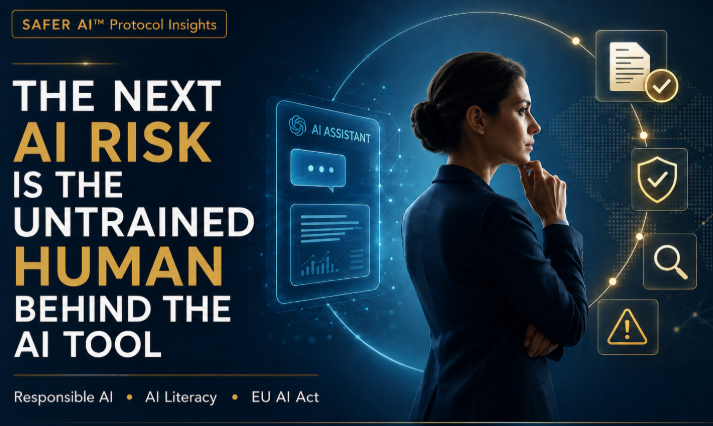
This is why I believe the next major AI risk is not just the model. It is the untrained human behind the AI tool.
Responsible AI cannot stop at model design, vendor evaluation, technical documentation, or policy statements. Those are important, but they are not enough. The most critical moment often happens after the AI generates output.
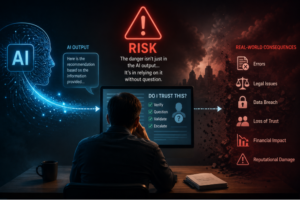
It is the moment a human decides:
Do I trust this? Do I use it? Do I share it? Do I act on it? Do I escalate it? Do I document it?
That moment matters. I call this the moment of reliance.
It is the point where AI output becomes human action, and in many organizations, that moment is still under-governed.
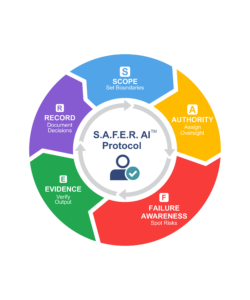
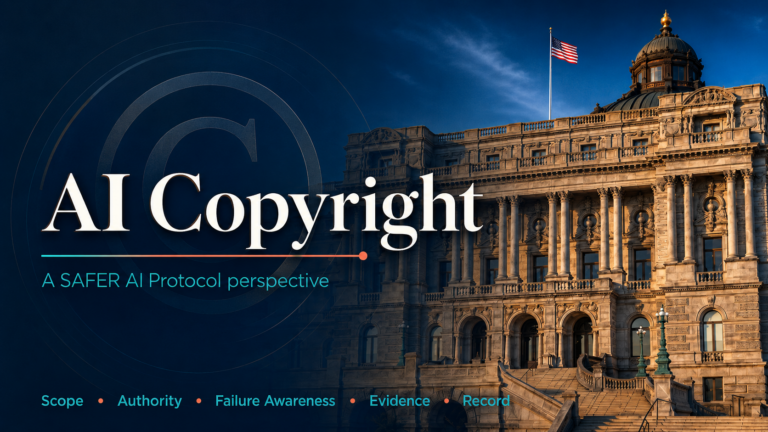
This is where human-centered AI governance becomes essential. Through my work with the SAFER AI™ Protocol, I continue to emphasize that responsible AI use should include five practical dimensions:
Scope – Is this AI tool being used for the right purpose and within the right boundaries?
Authority – Does the person using the AI have the authority to rely on the output for this type of decision?
Failure Awareness – Does the user understand how the AI system can be wrong, biased, incomplete, outdated, or misleading?
Evidence – What level of verification is needed before accepting or acting on the AI output?
Record – Was the decision, verification process, or human judgment documented when the stakes required it?
These questions are not designed to slow innovation. They are designed to make AI use more responsible, explainable, and defensible.
The EU AI Act makes this point even more important because its AI literacy requirement is not limited to technical developers. It also applies to deployers of AI systems, meaning organizations using AI must think seriously about whether their people have the knowledge, skills, and understanding needed to use AI systems appropriately in context.
That word context is important.
AI literacy cannot be generic. The risks faced by someone using AI in a classroom differ from those faced by someone using AI to support hiring, financial, legal, healthcare, or customer service decisions. A one-size-fits-all training session may introduce the tool, but it may not prepare people to recognize the risks, limitations, responsibilities, and decision boundaries connected to their specific work.
People need to understand the risks, limitations, responsibilities, and decision boundaries connected to the specific ways they use AI.
This is especially important because many AI failures will not look dramatic at first. They may begin as small moments of misplaced confidence. A person may skip verification because the answer looks polished. A team may rely on a recommendation because it appears neutral. A manager may approve of an AI-assisted decision because no one questioned the process.
These are not just technology problems. They are literacy problems. They are governance problems. They are accountability problems.
The organizations that understand this early will have a major advantage. They will be more compliant. They will be more trustworthy. They will build stronger AI cultures. They will reduce avoidable risks. They will prepare employees to use AI confidently without using it carelessly.
Most importantly, they will understand that AI governance is not only about controlling machines. It is about preparing humans, because the most dangerous AI user is not always the malicious actor.
Sometimes, it is the confident user who does not know what they do not know.
So here is my question:
Are organizations truly preparing people to use AI responsibly, or are they simply giving them access to powerful tools and hoping for the best?