Artificial intelligence is advancing faster than many institutions are prepared to govern it. Across sectors, organizations are adopting AI to improve efficiency, expand capacity, accelerate decisions, and strengthen competitiveness. Yet in many cases, systems are being implemented before governance has been clearly defined. That gap is no longer a minor oversight. It is becoming one of the most important leadership issues in AI adoption.
AI governance should not begin after deployment, after failure, or after public concern. It should begin at the point where leaders first decide to introduce AI into a workflow, service, process, or decision environment. Governance matters early because the most significant risks in AI rarely rest solely on technical performance. They are often tied to oversight, accountability, documentation, explainability, and whether the system is being used in ways that align with the institution’s values, obligations, and responsibilities.
Without clear AI governance, organizations can create problems that are difficult to unwind. A hiring tool may appear efficient while quietly narrowing opportunities if no one has defined acceptable use boundaries or reviewed outcomes for bias. A student-facing AI tool may be introduced as a support resource, but it can create confusion, inconsistency, or integrity issues if institutions have not established clear expectations for its use. A healthcare-related model may produce recommendations that seem useful on the surface, but without proper review and validation, those outputs can be trusted too quickly in high-stakes situations. In finance, lending, or risk review, an AI-assisted process may speed up decision-making, but accountability becomes harder to trace if documentation and oversight were never built into the workflow. In each case, the issue is not simply that AI exists. The issue is that AI has been implemented without sufficient governance for how it should be evaluated, supervised, and trusted.

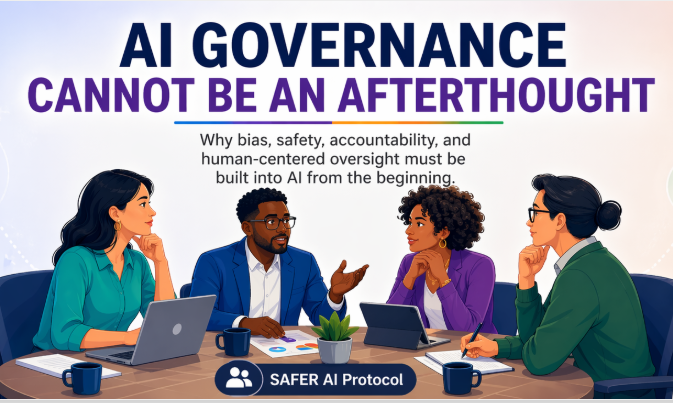
This is why AI governance cannot be treated as an afterthought. It is not a final checkpoint or a reactive compliance exercise. It is a foundational part of responsible adoption. Strong governance helps institutions define what AI is being used for, who is responsible for oversight, how risks are identified, how outputs are verified, and how decisions are documented for transparency and learning. In other words, governance is what turns AI from a promising tool into a defensible practice.
Too often, responsible AI is discussed in broad ethical language but not translated into an operational structure. Organizations may say they care about fairness, trust, and accountability, yet still lack a clear governance model for procurement, deployment, review, escalation, and recordkeeping. That is where leadership must become more intentional. Responsible AI requires more than aspiration. It requires a framework for disciplined action.
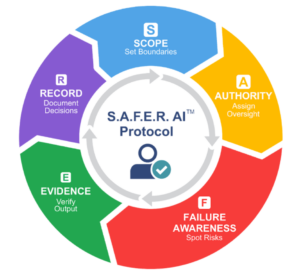
That is part of the thinking behind the S.A.F.E.R. AI™ Protocol, my human-centered approach to AI governance. Rather than treating responsible AI as an abstract principle, the framework helps move the conversation toward practical accountability. It emphasizes five governance dimensions essential to institutional readiness: Scope, Authority, Failure Awareness, Evidence, and Record. Together, these dimensions help organizations think more clearly about boundaries, oversight, risk, verification, and documentation before AI becomes embedded in decisions that affect people and outcomes.
This shift in thinking is especially important because AI does not operate in a vacuum. It affects access, evaluation, opportunity, communication, trust, and institutional credibility. When governance is weak, AI can amplify inconsistency, obscure responsibility, and scale flawed decisions faster than human systems alone. When governance is strong, organizations are better positioned to use AI with clarity, accountability, and care.
Human-centered oversight is also essential. AI governance that is designed without serious attention to impact can reproduce old exclusions in new forms. Systems may appear neutral while reflecting the limitations of the assumptions, data, and decision-making structures that underpin them. This is why governance must include more than technical review. It must also reflect thoughtful leadership, contextual judgment, and meaningful awareness of those most affected by the system.
The institutions that lead well in this era will not be those that simply adopt AI more quickly than everyone else. They will be those who understand governance as part of innovation itself. Trust, safety, accountability, and documentation are not barriers to progress. They are what make responsible progress sustainable.
We are entering a time when organizations will increasingly be asked not only what their AI systems can do, but how those systems are governed, who is accountable, what safeguards exist, and how decisions are justified. Those questions should not first arise during controversy or correction. They should be answered from the beginning.
AI governance cannot be an afterthought because the cost of delay is too high. It must begin with responsible leadership: clarity, structure, accountability, and a serious commitment to human-centered decision-making.
That is the conversation I will continue to advance through SAFER AI Protocol.
If this perspective resonates with your work, I invite you to share this newsletter with colleagues, leaders, and decision-makers who are also thinking seriously about the future of responsible AI.