The debate around copyrighting AI-generated output is becoming one of the most important questions in the age of generative AI. As more people use AI to write, design, code, create images, prepare presentations, and generate business content, the question is no longer only, “Can AI produce creative work?” The more urgent question is, “Can humans responsibly claim, reuse, publish, or commercialize AI-generated work without verifying its origin, authorship, and defensibility?”

Recent copyright discussions show that this issue is far from settled. The U.S. Copyright Office has continued to emphasize that copyright protection depends on human authorship, especially when evaluating outputs created with generative AI tools. Its AI report on copyrightability explains that human creative contribution remains central when determining whether AI-assisted work can receive copyright protection.
This debate became even more visible when the U.S. Supreme Court declined to hear Thaler v. Perlmutter, leaving in place lower-court decisions that rejected copyright protection for a work said to be created entirely by AI. The message is important: AI may be able to generate content, but copyright law still looks for meaningful human authorship, judgment, and creative control. Therefore, organizations should not treat this as only a legal issue. It is also a governance issue, an accountability issue, and most importantly, a verification issue.
This is where the SAFER AI™ Protocol comes into play!
When a person accepts an AI-generated output and decides to use it, they make a reliance decision. They are deciding that the output is good enough, accurate enough, original enough, safe enough, and defensible enough to move forward. That moment of reliance is where many AI risks begin.
For example, a student may submit AI-assisted writing without understanding whether the ideas are properly attributed. A business may publish AI-generated marketing content without checking whether it closely resembles protected material. A consultant may include AI-generated language in a client deliverable without documenting how it was reviewed. A company may commercialize AI-generated designs without understanding whether human creativity was meaningfully involved.
In each case, the risk is not simply that AI generated something. The risk is that a human or organization accepts and uses the output without a responsible verification process.

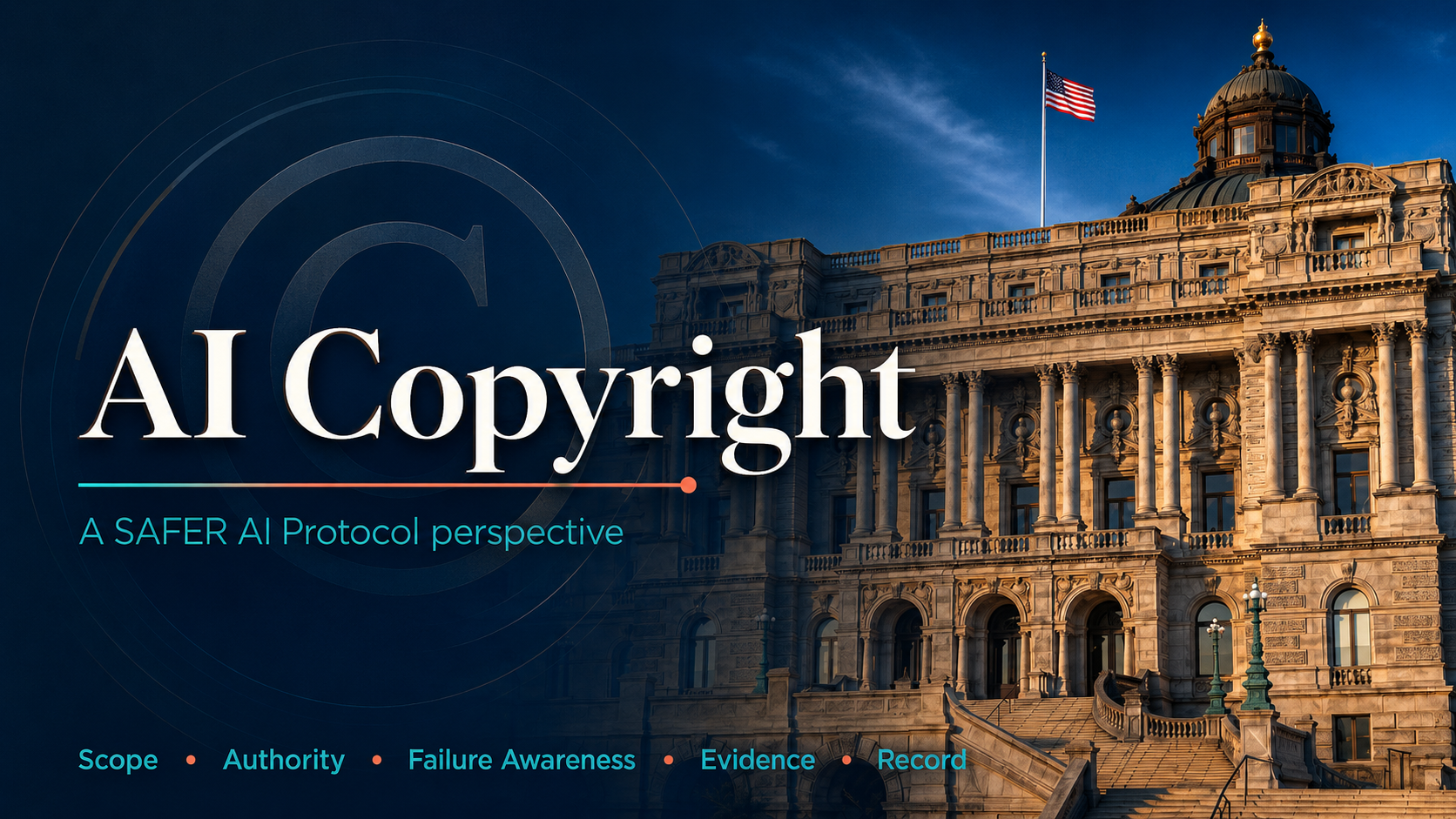
Under the SAFER AI Protocol, the copyright debate can be viewed through five practical questions:
Scope: What is the AI-generated output being used for?
A private brainstorm, classroom draft, public newsletter, commercial product, academic submission, or client deliverable does not carry the same level of risk.
Authority: Who has the authority to approve the use of this output?
Not every employee, student, creator, or team member should make high-risk publication or commercialization decisions without review.
Failure Awareness: What could go wrong if this output is reused or published?
The output may also be inaccurate, such as protected material, poorly attributed, misleading, or unsupported by meaningful human authorship.
Evidence: What evidence shows that a human meaningfully shaped, reviewed, edited, or transformed the work?
These matters because copyrightability often depends on the degree of human creative contribution, not merely the fact that a prompt was entered.
Record: Was the decision documented?
Organizations need a record of how AI-generated content was reviewed, modified, approved, and used. Without documentation, accountability becomes difficult.
This is why AI copyright should not be discussed only after a dispute arises. It should be part of everyday AI literacy and governance.
The most responsible question is not simply: “Did AI create this?”
The better question is: “What human judgment, verification, editing, and accountability occurred before this AI-generated output was accepted and used?”
For educators, this means students need more than rules saying, “do not use AI.” They need guidance on how to disclose AI use, verify AI outputs, document their contribution, and understand the difference between assistance and substitution.
For businesses, this means AI-generated content should not move straight from prompt to publication. There should be a review process that considers originality, source risk, human contribution, brand risk, and legal defensibility.

For creators, this means the value of human creativity is not disappearing. In fact, the copyright debate makes human judgment even more important. The more AI can generate, the more humans must be able to show how directed, selected, refined, and transformed it is, and take responsibility for the final work.
The future of AI copyright will continue to evolve. Courts, regulators, companies, and creators will continue debating where to draw the line between human-authored, AI-assisted, and AI-generated work. Legal experts have noted that many AI copyright lawsuits are still raising unresolved questions about training data, fair use, ownership, and infringement.
But while the law continues to develop, organizations do not have to wait before creating better internal practices. They can start by treating AI-generated output as something that requires verification before reliance on it.
AI may generate the content, but humans remain responsible for deciding whether that content should be trusted, claimed, published, submitted, or sold. This is why copyright in the age of AI is not only about ownership. It is about responsibility. It is about verification. It is about governing the moment of reliance.