
For years, conversations about artificial intelligence have focused heavily on access. Who can afford the technology, who has access to the most advanced models, who understands how to use AI tools, and which organizations are positioned to benefit from them have all been central questions in the AI conversation.
Those questions still matter, but they are no longer enough.
As generative AI becomes more widely available across workplaces, universities, healthcare systems, financial institutions, and public organizations, a different divide is emerging. The next AI divide may not simply be between people who have access to artificial intelligence and those who do not. It may be between people who know when to trust AI and people who do not. This distinction matters because access to AI is becoming easier while responsible judgment remains difficult.
Powerful AI tools can now summarize complex documents, generate reports, analyze information, write code, create presentations, support research, and assist with decision-making. Increasingly, AI systems are moving beyond providing suggestions to performing tasks and coordinating workflows.
OpenAI reported in 2026 that enterprise AI use is moving from simple assistance toward more meaningful delegation, with organizations increasingly allowing AI systems to perform substantive work rather than merely generate recommendations. This shift changes the nature of the conversation. The question is no longer simply whether AI can perform a task. The more important question is whether humans should rely on the result.
AI systems can process enormous amounts of information quickly and identify patterns that humans may overlook. They can generate convincing explanations and recommendations in seconds. But capability should not automatically be treated as authority.
An AI system can provide an answer that sounds persuasive and still be wrong. It can work with incomplete information. It can fail to understand important context. It can generate a response with great confidence even when uncertainty remains. This is why knowing how to use AI is not the same as knowing how to exercise judgment around AI.
Imagine two professionals using the same AI system and receiving the same recommendation. One person accepts the recommendation because the system appears sophisticated and the answer sounds credible. The other person stops and considers whether the evidence is sufficient, whether important information might be missing, what the consequences would be if the recommendation were wrong, and whether additional verification or expert review is necessary.
Both individuals have the same access to AI. What separates them is judgment.

That difference becomes even more important when AI is used in situations where decisions can affect people’s lives. An inaccurate restaurant recommendation may cause inconvenience. An inaccurate AI-assisted recommendation involving healthcare, lending, employment, education, security, or public services can create far more serious consequences.
Technology may be similar, but the level of acceptable reliance should not be. This is one of the reasons AI governance cannot exist only in policies, committees, or compliance documents. Governance must also reach the moment when a human decides whether to accept and act on an AI-generated output.
The idea of keeping a “human in the loop” is often presented as a safeguard, but simply involving a human does not guarantee meaningful oversight. If humans routinely approve of what the AI recommends without questioning it, the presence of a person may provide little real protection.
Meaningful human oversight requires judgment. It requires understanding when AI output needs additional evidence, when uncertainty should prompt escalation, when a decision exceeds someone’s authority, and when the potential consequences of an error are too serious to justify immediate reliance.

Current research suggests that this governance challenge is becoming increasingly important. Deloitte’s 2026 State of AI in the Enterprise research reported that only about one in five surveyed organizations had mature governance models for autonomous AI agents, even as many organizations expected their use of agentic AI to increase significantly. This gap deserves attention.
Organizations can acquire AI capabilities faster than building cultures of responsible use. They can automate workflows faster than they can establish clear accountability. Employees can learn how to generate impressive AI outputs much faster than they can learn how to evaluate whether those outputs deserve trust. This is why the next stage of AI literacy must move beyond prompting.
People need to understand not only how to communicate with AI systems, but also how to question them, verify their outputs, recognize uncertainty, evaluate evidence, understand limits of authority, and make defensible decisions when AI is involved.
The goal should not be to distrust artificial intelligence. The goal should be to understand when reliance is justified.
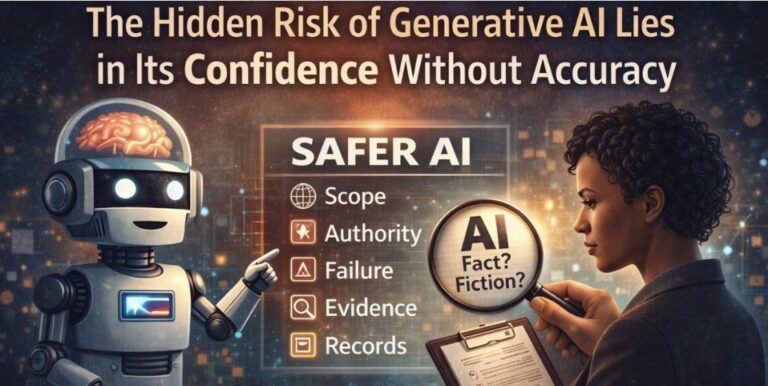
This idea is also central to the SAFER AI Protocol™, which I developed around Scope, Authority, Failure Awareness, Evidence, and Record. The framework focuses on the moment when an AI-generated output becomes a human decision because someone chooses to accept and act on it. That moment deserves far more attention in the AI conversation.
Deloitte also reported in 2026 that 75 percent of surveyed leaders agreed that collaboration between humans and AI agents creates more value than AI-agent-powered automation alone. That finding points toward an important possibility.
The organizations that benefit most from AI may not necessarily be the ones that remove humans from decision-making fastest. They may be the ones who become better at combining machine capability with human judgment. As access to powerful AI systems continues to expand, having the technology itself may become less of a differentiator. The real advantage may belong to people and organizations that know when AI deserves trust, when it deserves verification, when it requires escalation, and when it should simply be rejected.
The next AI divide may therefore be much more than a technology gap. It may be a judgment gap. And as artificial intelligence becomes more capable and more deeply embedded in everyday decisions, closing that gap may become one of the most important challenges of the AI era.