Without a doubt, Artificial intelligence (AI) is now part of many business operations. Companies use it to draft documents, support customer service, summarize information, analyze data, automate tasks, assist employees, and support decisions. In many organizations, employees begin using AI tools before the company has created policies that define how those tools should be used.
This creates a gap between access and governance. A business may have AI in use across several departments without having decided what information employees can enter these systems, what types of decisions AI can support, who is responsible for reviewing outputs, or what should happen when the system produces an incorrect result.
For this reason, the first question a business should ask is not which AI platform to purchase. It should first determine where AI fits within its operations and what level of risk each use entails. Using AI to draft a meeting agenda does not carry the same consequences as using it to evaluate an employee, interpret financial information, communicate with a customer, review a contract, or recommend an action that affects another person.

Screenshot
Data is one area that requires attention before the broad adoption of AI. Employees may enter customer information, internal documents, financial records, intellectual property, or confidential business information into AI tools without understanding how that information is processed or retained. Organizations need to establish what information may be entered into approved systems, what information should remain outside those systems, and whether vendors’ data practices meet the organization’s privacy, security, and contractual requirements.
The use of third-party AI systems also raises questions about responsibility. A vendor provides the technology, but the organization decides how the technology will be used. The business determines who has access to it, what information is supplied to it, which functions are connected to it, and whether employees are allowed to rely on its output. Purchasing an AI product does not transfer responsibility for these decisions to the vendor.
Organizations also need to define the role of human judgment. The phrase “human in the loop” is often used in AI discussions, but having a person somewhere in a process does not automatically create oversight. The person reviewing an AI output must understand what they are expected to review, have enough knowledge to question the result, and have the authority to reject or escalate it when necessary. Without those conditions, human review can become little more than approval of what the system has already recommended.

Screenshot
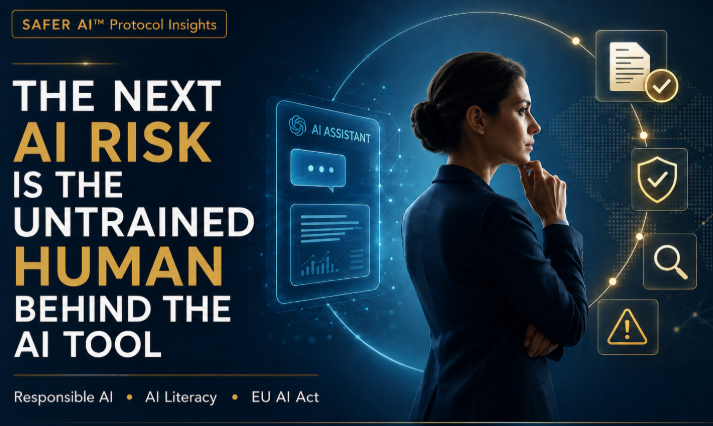
Employee training, therefore, needs to extend beyond prompt writing and tool features. Employees should understand what the organization permits users to access, which information they should not provide to an AI system, when an output requires verification, and when a task should be referred to someone with greater authority or subject-matter expertise. An employee who knows how to generate a useful response but does not know when to question it can still pose a risk to the organization.
Testing also needs to reflect how an AI system will be used in practice. A product demonstration or pilot can show that a tool works under selected conditions, but day-to-day use introduces different users, data, requests, and circumstances. Organizations need processes to review performance after deployment, identify recurring errors, and determine whether a system should continue to be used as is.
Cost savings and efficiency are often part of the business case for AI, but they should not be the only measures considered. Organizations also need to understand what happens when an output is wrong, who may be affected by that error, whether the decision can be corrected, and whether the organization can explain how the outcome was reached. These questions matter more as AI moves closer to decisions involving customers, employees, finances, compliance, or other areas where errors can create consequences beyond lost time.
Documentation is part of this responsibility. When AI contributes to a decision that carries business or human consequences, an organization should be able to identify what role the system played, what information was considered, what review occurred, and who accepted the final decision. Without a record of that process, accountability can become difficult when an outcome is challenged.
These issues connect to the work I have been developing through the SAFER AI™ Protocol. The framework focuses on Scope, Authority, Failure Awareness, Evidence, and Record. In a business setting, this means defining where AI may be used, identifying who retains decision-making authority, considering how the system could fail, determining what evidence is needed before an output is accepted, and maintaining a record when AI contributes to a decision.
Businesses do not need to avoid AI to manage these concerns. They do, however, need to make decisions about its use before informal experimentation turns into routine dependence. Once an AI tool becomes part of everyday work, changing poor practices can be harder than establishing expectations at the start.
As organizations consider new AI tools and applications, the discussion should extend beyond what technology can do. It should also address what the organization is prepared to allow it to do, what safeguards will support its use, and who will remain accountable for the decisions that follow. Responsible AI adoption starts with those choices, not with the technology itself.