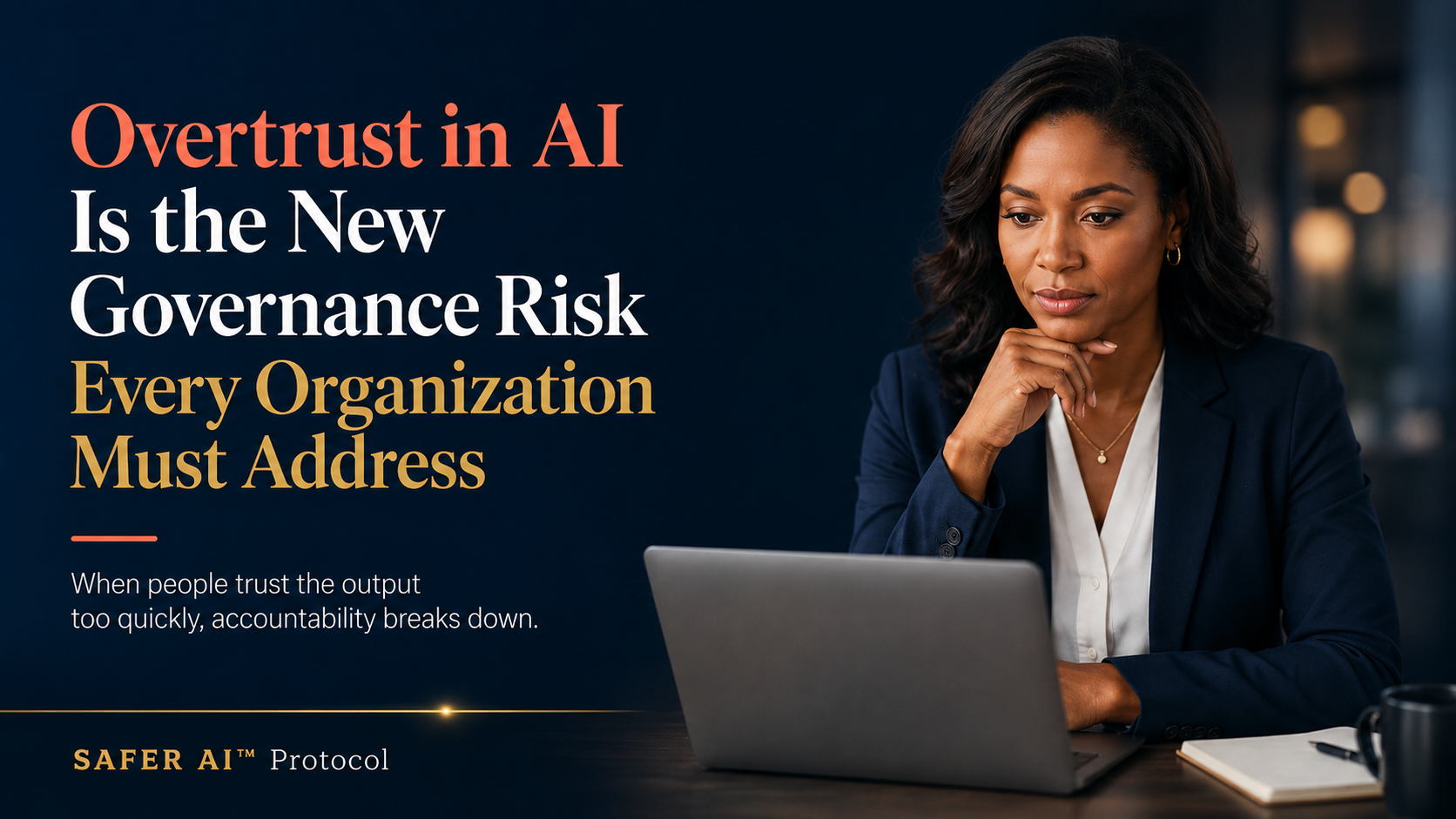
The biggest risk in your organization may not be the tool itself. It may be how quickly people believe what the tool gives them.
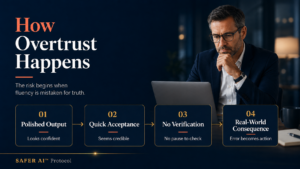
Across industries, people are using artificial intelligence to write, summarize, research, advise, analyze, and make work faster. That speed is useful, but it also creates a quiet danger. When an answer looks polished, many people assume it is accurate. When a system responds with confidence, many users stop questioning it. When a task is completed quickly, the need for careful review can feel less urgent; this is where overtrust begins!
Overtrust happens when people accept an AI-generated answer without slowing down to verify it. It happens when professionals rely on a tool because it sounds right, not because they have confirmed that it is right. In many workplaces, the real risk is no longer just whether AI makes mistakes. The risk is whether humans catch those mistakes before they act on them.
Recent events are already showing why this matters.
In June 2026, Reuters reported that a federal judge in Mississippi disqualified attorneys on both sides of a lawsuit after they relied on unverified AI-generated legal research that included fabricated case citations. The judge made it clear that lawyers may use these tools, but they remain responsible for verifying the accuracy of what they submit to the court.
That case is important because it was not only a technology problem. It was a human judgment problem. The tool produced unreliable information, but professionals still trusted it enough to use it in a serious legal matter.
A similar concern appeared in consulting and public-sector work. In 2025, Deloitte Australia agreed to provide a partial refund to the Australian government after a report prepared with the help of generative tools contained errors, including references to non-existent entities. The report had to be corrected and republished.
Again, the lesson is not that organizations should avoid AI. The lesson is that professional work still requires professional responsibility. If a firm, school, business, hospital, agency, or consultant uses AI to support work, someone must still review the output, confirm the evidence, and take responsibility for the final result.
The Air Canada chatbot case also showed how this issue can affect everyday customers. A tribunal found that Air Canada was responsible for misleading information provided by its chatbot about bereavement fare refunds. The company could not simply distance itself from the tool when a customer relied on the information it provided.
These examples point to the same concern. The danger is not only that AI can be wrong. The danger is that people and organizations may act as if the answer is right before anyone has properly checked it. This is why overtrust must be treated as a governance issue.
Good governance is not only about choosing the right platform or writing a policy that says “use AI responsibly.” It is about creating clear expectations for how people should use the output. Who reviews it? Who verifies it? What level of evidence is needed? When should a person escalate the issue rather than accept the answer? Who is accountable when something goes wrong? These questions matter because the moment of reliance is where risk becomes real.
An AI-generated answer sitting on a screen is one thing. A person using that answer to grade a student, advise a client, screen an applicant, guide a patient, prepare a legal filing, approve a loan, write a report, or make a business decision is something else entirely. This is the point where governance must become practical.
Stanford’s 2026 AI Index also shows why this conversation is urgent. The report noted that documented AI incidents rose to 362 in 2025, up from 233 in 2024, while responsible AI practices and safety evaluation are still struggling to keep pace with adoption.
This gap should concern every leader. Organizations are moving quickly to adopt AI, but many are not adopting the same urgency to teach people to question, verify, and document what they accept.
In my view, this is where AI literacy and governance meet.
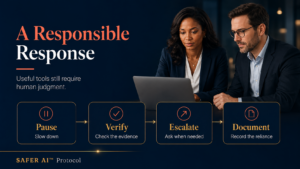
People do not only need to know how to prompt a system. They need to know when not to trust it. They need to know when a polished answer still requires evidence. They need to know that speed does not remove responsibility. They need to understand that if they do not sign their name to the output, they should not rely on it without further review. This is what I call the AI Reliance Test.
Before accepting an AI-generated output, ask one simple question: Would I be willing to defend this if it turned out to be wrong?
That question changes the conversation. It moves people from passive use to responsible judgment. It reminds employees, educators, consultants, leaders, and students that AI can assist with work but should not replace accountability.
The future of responsible AI will not be built only by better tools. It will also be built on better human habits.
Organizations that want to use AI well must teach people to pause before they trust. They must create a culture where verification is not seen as a delay, but as part of responsible work. They must make it normal to request evidence, conduct document review, and escalate high-risk decisions.
The biggest governance failure may not come from organizations that refuse to use AI. It may come from organizations that use it everywhere but trust it too easily. That is why overtrust in AI is no longer a minor concern. It is a governance risk every organization must address.
I would love to hear from leaders, educators, researchers, consultants, and responsible innovation professionals: Should overtrust in AI be treated as a formal governance risk in organizations?