AI is moving from experiment to everyday practice faster than many institutions are prepared to govern it.
This is no longer a future conversation. Students are using AI to study, write, brainstorm, summarize, code, translate, and prepare for exams. Faculty are using AI to design lessons, draft rubrics, generate examples, give feedback, and support administrative tasks. Employees are using AI to prepare reports, write emails, summarize meetings, analyze documents, develop presentations, support customers, and speed up workflows. Leaders in education, business, healthcare, government, finance, and nonprofit organizations are under pressure to show that they are not falling behind.
The problem is not that people are using AI. The problem is that many institutions are adopting AI faster than they are building the rules, training, accountability, and review structures needed to use it responsibly. That is the AI governance gap in institutions.


This gap is the space between access and accountability. It is the distance between telling people to innovate and teaching them how to evaluate AI output. It is what happens when institutions buy AI tools, encourage productivity, or allow experimentation without clearly defining what data is protected, what use cases are acceptable, what outputs must be reviewed, and who is responsible when something goes wrong.
The Stanford AI Index Report 2025 shows how quickly this shift is happening. It reported that 78% of organizations used AI in 2024, up from 55% in 2023, and that generative AI use in at least one business function rose from 33% in 2023 to 71% in 2024. Those numbers make one thing clear: AI adoption is not waiting for perfect policies. It is already embedded in learning, work, and decision-making.
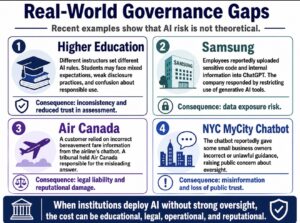
In higher education, many institutions still treat AI mainly as an academic integrity issue. That concern is real, but it is incomplete. Faculty worry about students submitting AI-generated assignments without proper disclosure. Students are confused because one instructor may allow AI for brainstorming while another may prohibit it entirely. Some students use AI as a tutor, while others use it as a shortcut. Some faculty redesign assignments, while others continue using the same assessments, hoping that detection tools will solve the problem.
The consequence is inconsistency. Students may not know what responsible AI use looks like across courses. Faculty may feel unsupported. Academic integrity offices may be forced to respond after the damage has already happened. Programs may graduate students who know how to prompt a tool but do not know how to question, verify, cite, or ethically apply AI-generated information.
This is why AI governance in education must go beyond punishment. It must include AI literacy, faculty development, student guidance, assessment redesign, data privacy, disclosure practices, and clear institutional expectations. Students need to understand that AI output can be useful even when it’s wrong. They need to know that AI-generated text is not automatically evidence. They also need to understand that entering personal, institutional, or research data into an AI system may create privacy and confidentiality concerns.
Faculty also need support. It is not realistic to expect instructors to manage AI disruption alone. Faculty need examples of acceptable use statements, guidance on when to allow or restrict AI, and training on how to design assignments that measure thinking rather than mere content production. Without institutional backing, AI expectations are left to individual interpretation, which creates confusion for both faculty and students.
The corporate world is facing a similar challenge, but the consequences often appear as data exposure, customer harm, legal liability, reputational damage, and operational risk.
Screenshot
One real example is Samsung, which reportedly restricted employee use of generative AI tools after staff uploaded sensitive code and internal information into ChatGPT. The deeper lesson is not simply that employees made a mistake. The lesson is that many employees are trying to work faster in environments where the boundaries around AI use are not yet strong enough. Without clear rules, confidential information can leave the organization before anyone realizes the risk.
Another real example is the Air Canada chatbot case. A customer relied on incorrect information provided by the airline’s chatbot about bereavement fares. When the dispute reached the British Columbia Civil Resolution Tribunal, Air Canada was found responsible for the misinformation provided by its chatbot and was ordered to compensate the customer. The governance lesson is direct: organizations cannot simply blame the AI system when customers are misled. If an institution deploys a chatbot as part of its service experience, it must govern accuracy, review, escalation, and accountability.
The same concern has appeared in the public sector. New York City’s MyCity chatbot was reported to have given small business owners incorrect and potentially unlawful advice. That example shows how institutional trust can be damaged when AI tools are deployed in public-facing environments without strong safeguards. When a chatbot gives incorrect information about law, employment, housing, safety, or compliance, the harm can go beyond inconvenience. People may make decisions based on the guidance they receive.
These examples show that the AI governance gap is not theoretical. It shows up when a student submits work that they cannot explain. It arises when a faculty member is unsure whether AI use should be reported, allowed, or penalized. It occurs when an employee uploads confidential data to an external tool. It shows up when a chatbot gives a customer the wrong answer. It shows up when a public agency provides AI-generated guidance that people may treat as official.
The consequences can be serious. In education, they include weakened academic integrity, inconsistent expectations, overreliance on AI, reduced critical thinking, privacy risks, and loss of trust in assessment. In corporate settings, they include exposure of confidential data, inaccurate decision support, customer misinformation, regulatory risk, intellectual property concerns, and reputational damage. In public institutions, the consequences can affect citizens directly when people rely on AI-generated information about benefits, compliance requirements, legal obligations, healthcare access, or education services.
Screenshot
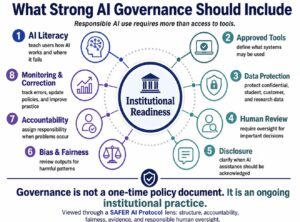
This is why AI governance must be practical. It cannot remain at the level of broad principles such as fairness, transparency, and accountability. Those principles matter, but they must be translated into daily decisions. Institutions need to ask which AI tools are approved, which data are prohibited, which tasks require human review, what disclosures are expected, how errors will be reported, and who owns the risk.
The National Institute of Standards and Technology’s AI Risk Management Framework emphasizes managing AI risks to strengthen trustworthiness and public trust. That is a useful reminder because AI governance is not about slowing innovation. It is about making innovation sustainable. Institutions that ignore governance may move quickly at first, but they often pay later through confusion, complaints, legal exposure, rework, or loss of credibility.
Strong AI governance should begin with leadership, but it cannot remain there. Academic leaders need to involve faculty, students, instructional designers, technology teams, research offices, accessibility experts, and compliance stakeholders. Corporate leaders need to involve cybersecurity, legal, HR, data governance, product teams, customer-facing teams, and risk leaders. AI is no longer owned by one department. Its risks and benefits move across the entire institution.
Through my work on the SAFER AI™ Protocol, I continue to see that the institutions best positioned for the AI era are not necessarily the ones adopting the most tools. They are the ones building responsible habits around AI use. They are asking better questions before deployment. They are training people before problems occur. They are creating room for innovation while still protecting privacy, fairness, evidence, reliability, and human accountability.
The goal is not to make people afraid of AI. Fear does not create readiness. The goal is to help people understand that AI can be powerful and risky at the same time. It can improve productivity and still produce errors. It can support learning and still weaken learning if used carelessly. It can help employees move faster, but it can still expose confidential information if boundaries are unclear.
The institutions that will lead in the AI era will not be those that simply announce they are using AI. They will be the ones who can answer hard questions with confidence: What are we using AI for? What are we not using it for? What data must be protected? When is human review required? How do we teach responsible use? How do we correct errors? How do we protect trust?
That is the real AI governance gap in institutions. It is not just a technology gap. It is a readiness gap. It is a leadership gap. It is a training gap. It is a policy gap. It is a trust gap. And it is one that institutions should address now, before AI becomes even more deeply embedded in the classrooms, offices, systems, and decisions that people depend on every day.
Note: Examples referenced are based on public reports and published AI governance resources, including the Stanford AI Index, NIST AI Risk Management Framework, EDUCAUSE, and publicly reported chatbot and workplace AI cases.