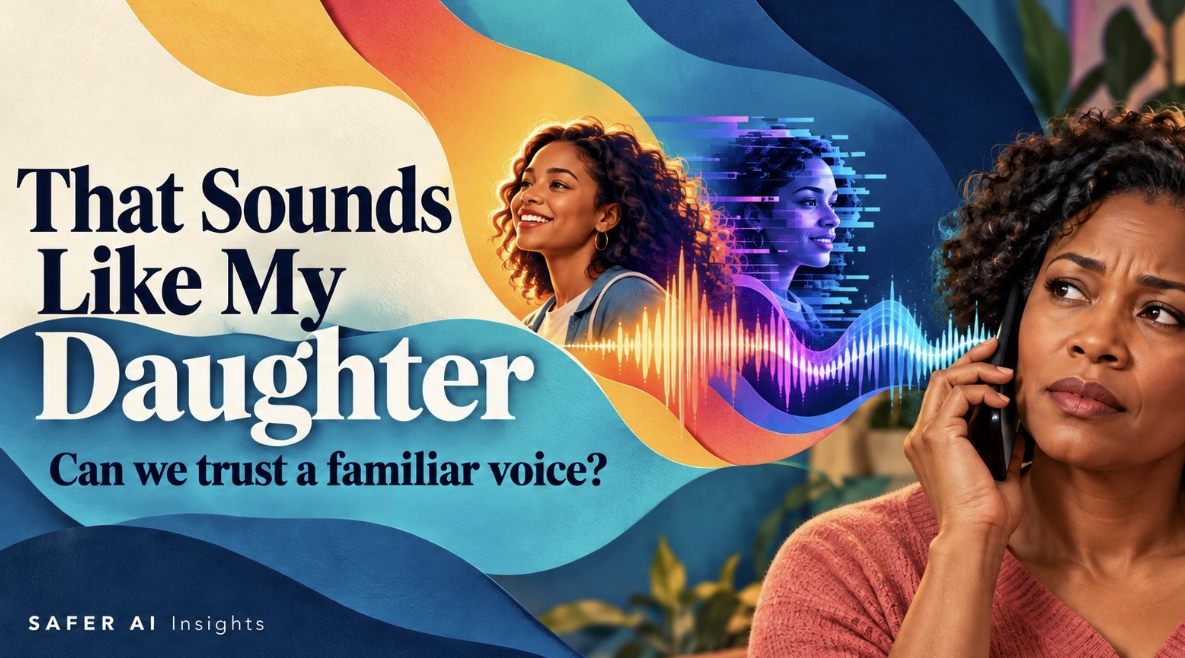
Imagine answering your phone and hearing your frightened daughter asking for help. Someone else takes over the call and says you must send money immediately.
Before you have time to think, you are trying to protect someone you love.
This is an illustrative scenario, but the threat behind it is real. Artificial intelligence (AI) can help scammers imitate familiar voices, making an urgent request feel deeply personal.
On October 19, 2026, the International Criminal Police Organization (INTERPOL) launched a public awareness campaign warning about AI-generated and altered media used in fraud. Its warning reaches beyond celebrities and politicians: ordinary people can be targeted through impersonation, investment scams, and other forms of deception.
For me, this raises a practical question about responsible AI: What should we verify before we act on something that feels real?
The Federal Trade Commission (FTC) explains that scammers can use a short recording, potentially taken from online content, along with voice-cloning software to imitate a loved one. Hearing a familiar voice, therefore, does not establish that the person is who they claim to be.
We need to separate two judgments that can easily become one: “I recognize that voice” and “I have confirmed this request.”
This distinction matters because these scams combine apparent familiarity with pressure. The FTC describes callers who insist on immediate payment, demand secrecy, or pretend to be an authority figure helping a relative. Those tactics discourage the very conversations that could expose deception. The most useful response does not require becoming an expert at detecting synthetic audio. The FTC recommends contacting the person through a phone number you already know is theirs. If you cannot reach them, contact another trusted relative or friend to check the story.
The purpose is to obtain confirmation outside the suspicious conversation. Asking the same caller to reassure you leaves that caller in control of the evidence.

Families can also prepare before an emergency occurs. INTERPOL recommends agreeing on a private safe word or question for suspicious calls. I would treat that as an additional check while continuing to independently verify unusual requests. INTERPOL also advises contacting your bank promptly if you have made a payment and reporting suspected scams to local law enforcement.
This belongs to workplace conversations, too. INTERPOL recommends staff training and multiple verification steps for financial transactions or data transfers. An organization could put that principle into practice by requiring a separate approval through an established internal channel before processing an unusual payment request, even when the request appears to come from a senior leader.

My recommendation is that employees should have explicit permission to pause and check. A verification procedure becomes difficult to follow if people believe questioning an urgent instruction will get them into trouble. This is where AI governance becomes tangible. It shapes who can authorize an action, what evidence is sufficient, and whether someone has the support to stop when something seems wrong.
In my SAFER AI Protocol work, I describe the point at which information becomes the basis for action as the moment of reliance. In this situation, there comes a moment when a familiar-sounding voice becomes a reason to transfer money or disclose information. This is where I would place the strongest check. We should not expect frightened parents or busy employees to become forensic investigators. We can, however, make independent verification a familiar habit before a stressful call puts that habit to the test.
If someone called today and sounded exactly like someone you trust, what would you do to verify the request before acting?